Integration and Resilience of Youth Entrepreneurship Initiatives for Sustainable Food Systems (IRIS)
Background
Benin faces a two-pronged challenge: providing viable economic opportunities for its rapidly growing youth population and supporting the necessary transition to sustainable food systems.
These challenges are particularly acute in the departments of Atacora and Borgou, in the north of the country. These rural areas, marked by poverty, youth underemployment, and repeated climate shocks, are seeing their agricultural systems weakened. Borgou, considered the country’s breadbasket, is experiencing severe soil degradation and growing pressure on natural resources. Atacora, which is more landlocked and mountainous, suffers from its isolation and limited access to markets. In these regions bordering Burkina Faso, Niger, and Nigeria, growing insecurity exacerbates precarious living conditions and exposes vulnerable young people to the risk of marginalization or recruitment by armed groups.
In addition, there is a whole range of structural barriers that further limit women’s access to productive resources and education, or restrict their ability to engage in entrepreneurial initiatives.
Thus, the central challenge is to create a supportive and secure entrepreneurial environment that enables young people—and women in particular—to establish themselves long-term in promising green sectors, while contributing to food security, environmental sustainability, and the social resilience of local communities.
Financial Partners
Location
Northern Benin (municipalities of Natitingou, Toucountouna, and N’Dali)
Objectives
The overall objective to which this project contributes is the promotion of sustainable and inclusive economic and food systems that create decent jobs for young women and men in green sectors.
Specifically, the project aims to help young entrepreneurs (both women and men) establish sustainable businesses and achieve economic success in green sectors by strengthening their skills, providing access to productive resources, and promoting their initiatives in sustainable markets.
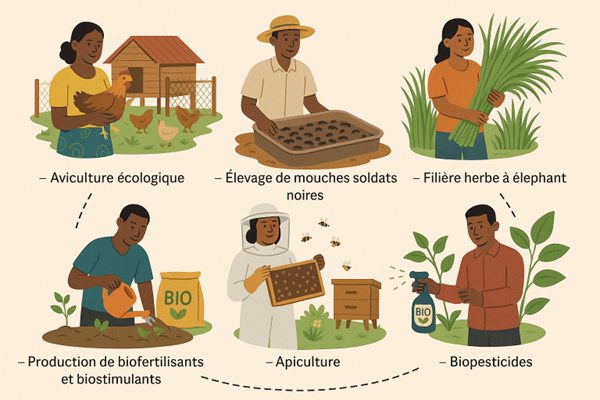
The sectors involved in the IRIS project are as follows:
Expected impacts/results
Building on the success of the Osez Entreprendre project, IRIS builds on existing achievements by strengthening support for beneficiaries and helping to ensure the long-term viability of their initiatives.
The project is structured around three main areas:
- Building the skills of young green entrepreneurs: Young people receive in-depth entrepreneurial assessments and modular training programs that combine theory and practice. These training programs aim to develop strong technical, organizational, innovative, and entrepreneurial skills;
- Economic integration and access to resources: Young people are supported in developing realistic business plans and receive startup kits, working capital, and additional financing from a guarantee fund managed by Ucoopia through a Decentralized Financial Service (SFD). An integrated small farm will serve as an incubation hub, complemented by individualized coaching and mentoring;
- Promoting initiatives and market access: Entrepreneurial success stories are documented and shared to inspire other young people and raise the profile of green careers. Tailored partnerships and distribution channels will help ensure access to markets.
Beneficiaries
265 young people, including 100 new participants (30% of whom are young women), and the 165 young people who received support through the Osez Entreprendre program, who will continue to receive post-program support.
Operational partners
Adesia and ANAF-Benin

Duration
January 2026 – December 2028 (3 years)
Contacts
Gallery
The latest news on this project
Aucun article trouvé.