Agroecological and Safe Food System Transitions (ASSET)
The ASSET project aims to make food and agricultural systems more sustainable and inclusive through agroecology.
Background
Agricultural systems in Southeast Asia are at a crossroads between conventional intensive models and emerging agroecological approaches. The continued intensification of conventional models, which rely heavily on chemical inputs and capital, is leading to the simplification of agricultural landscapes, soil degradation, and biodiversity loss, as well as increased health risks for farmers and consumers. In addition, beyond food and nutrition security, high levels of pesticide residues, risks of food contamination, and contamination of soil and aquifers are major concerns. Interestingly, agroecological approaches offer a growing range of agricultural and business innovations that promote healthier, more environmentally friendly, and sustainable practices.
Financial partners



Location
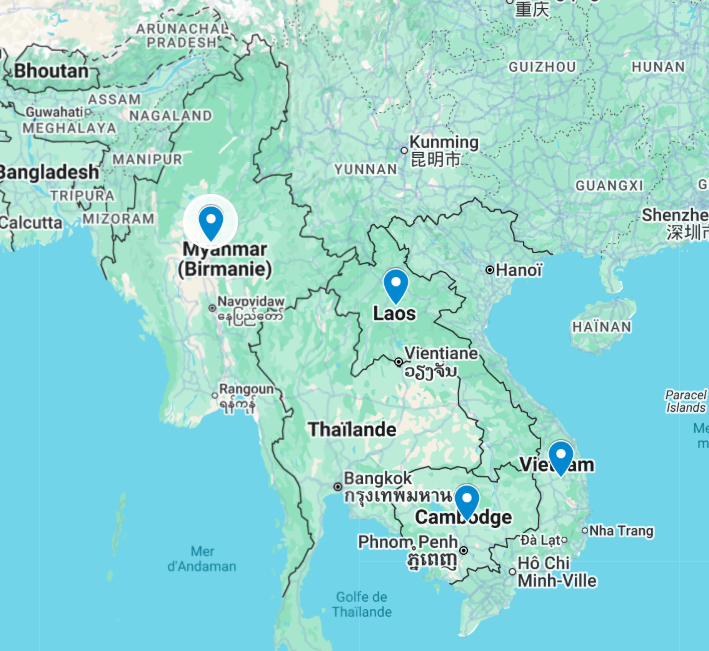
Cambodia, Laos, Myanmar, Vietnam
Objectives
The overall objective of the ASSET (Agroecological and Safe Food System Transitions) program is to make food and agricultural systems in the region more sustainable, safer, and more inclusive by harnessing the potential of agroecology to transform them.
SDG

Expected impacts/results
ASSET will develop and promote a shared vision of agroecology and the transition to healthy food systems through a comprehensive approach that includes research, networking, policy advocacy, capacity building, awareness raising, and communication using the ALiSEA (Agroecology Learning Alliance in Southeast Asia) network.
The consortium will engage with governments, civil society, the private sector, and smallholder farmers to generate and transform knowledge into sustainable innovation processes and transformative policies that are youth- and gender-responsive.
By encouraging technical, organizational, and institutional innovations at the territorial level in flagship programs, generating solid evidence on their performance and impact, scaling up successful approaches, and building on reliable regional initiatives and institutions, ASSET will contribute to opening a dialogue on the link between agricultural and market transformations in local, national, and regional policy frameworks.
More information at asset-project.org
Operational partners
The ASSET project is implemented by GRET as general coordinator, in close collaboration with CIRAD, which is responsible for scientific coordination, in partnership with a consortium of 23 international/European/national institutions and organizations (including Ucoopia via Uni4Coop) and two United Nations agencies.
Budget
€15 million
Duration
2020–2025
Contact persons
Gallery
The latest news on this project
Aucun article trouvé.